


Article Highlights
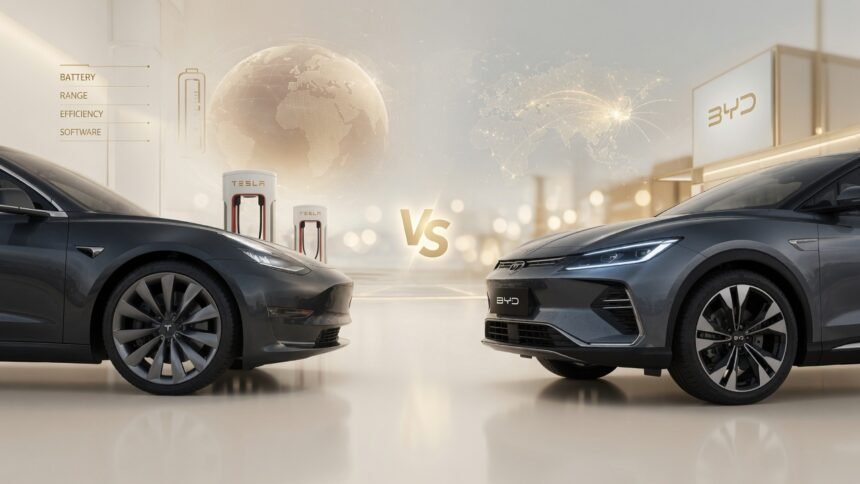
- BYD is challenging Tesla by outproducing and, in several recent quarters, outselling it in pure electric vehicle deliveries worldwide.
- BYD’s blade battery technology gives it a real cost and safety advantage that helps explain why BYD is better than Tesla for many budget-conscious buyers.
- BYD’s global expansion into Europe, Southeast Asia, and Latin America is reshaping BYD’s market share outside its home turf in China.
- Byd sales vs Tesla figures have flipped back and forth in 2026, showing this is now a genuine two-horse race rather than a one-sided contest.
- Tesla still leads in software, charging infrastructure, and premium branding, so the competition is far from settled.
How BYD Is Challenging Tesla? – Intro
I have been following the electric vehicle industry closely for years, and I can honestly say that nothing has surprised me more than watching BYD challenge Tesla in a way that once seemed impossible. A few years ago, Tesla was treated as the only real name in electric cars. Today, that picture looks very different. BYD, a company that started out making batteries before it ever built a car, has grown into a manufacturer that can match Tesla on volume, undercut it on price, and in some regions, outsell it completely.
This shift did not happen overnight. It is the result of years of investment in battery technology, factory expansion, and an aggressive push into markets outside China. In this article, I want to walk through exactly how BYD is beating Tesla in some areas, where Tesla still holds an edge, and what this rivalry means for anyone thinking about buying an electric car in the near future.
A Quick Look at Where Things Stand in 2026
The numbers from this year tell a story of a market that keeps swinging back and forth. In the first quarter of 2026, Tesla delivered about 358,000 fully electric vehicles, edging past BYD after BYD’s domestic sales in China slowed down due to new tax rules. Just one quarter later, BYD came roaring back, delivering roughly 557,000 battery electric vehicles compared to Tesla’s estimated 396,500 for the same period. That is a gap of more than 160,000 vehicles in BYD’s favor.
Looking at the bigger picture, BYD sales vs Tesla for the first half of 2026 show BYD with around 867,000 battery electric vehicles delivered against Tesla’s 838,000. The gap is not huge, but it confirms that BYD is challenging Tesla for the top spot on a consistent basis rather than as a one-time event. This back and forth is exactly why so many industry watchers now describe the EV race as a genuine rivalry instead of a market that one company owns.
How BYD Built Its Battery Advantage
One of the biggest reasons BYD electric cars have become so competitive comes down to something most drivers never see: the battery pack itself. BYD makes its own batteries through its blade battery technology, a design that packs cells tightly together for better space efficiency and improved safety during impact or thermal stress. Because BYD controls its own battery supply chain from raw material to finished pack, it avoids a lot of the cost and supply pressure that other automakers face when they depend on outside battery suppliers.
This vertical integration is a major part of why BYD is beating Tesla on price in many markets. When a company builds its own batteries, motors, and even some of its own chips, it can offer electric vehicles at price points that are hard for competitors to match. For everyday buyers, this often means getting a well-built electric car without paying a premium price, which is a big part of why BYD battery technology gets so much attention from industry analysts.
Global Expansion Beyond China
For a long time, BYD was seen mostly as a domestic Chinese brand. That has changed fast. BYD’s global expansion is now one of the clearest signs that the company wants to compete with Tesla on every continent, not just at home. BYD has been steadily increasing exports to Europe, Southeast Asia, and Latin America, with the company aiming for more than one million overseas deliveries in 2026 alone.
In parts of Europe, BYD has already outsold Tesla in monthly registrations, including in some of the region’s largest EV markets. That is a significant shift, since Europe has traditionally been one of Tesla’s strongest regions outside the United States. This growing footprint is directly reflected in BYD market share numbers, which continue to climb in regions where BYD was barely present just a few years ago.
Why BYD Is Better Than Tesla for Some Buyers
I want to be fair here, because the question of why BYD is better than Tesla really depends on what a buyer is looking for. For people who care most about price, model variety, and getting the most range and features for their money, BYD often wins. The company offers a wide range of vehicles, from compact hatchbacks to larger SUVs, and it updates its lineup quickly to match changing consumer demand.
BYD also builds plug-in hybrids alongside fully electric models, which gives buyers in markets with limited charging infrastructure more flexibility. This dual approach has helped BYD capture a broader slice of the overall new energy vehicle market, not just the pure electric segment where it competes directly with Tesla.
Where Tesla Still Holds the Edge
It would not be an honest article if I only talked about BYD’s strengths. Tesla still leads in areas that matter a great deal to many buyers. Its Supercharger network remains one of the most reliable fast charging systems in the world, and its software, including driver assistance features, is still considered more advanced by most reviewers. Tesla also holds a stronger brand image in markets like the United States, where BYD currently has little to no consumer presence.
Tesla’s manufacturing efficiency and its ability to update vehicles through software rather than hardware changes also give it flexibility that traditional automakers, and even BYD, are still working to match. So while BYD is challenging Tesla in sales volume and pricing, Tesla is not standing still, and its focus on software and energy products keeps it competitive in ways that go beyond simple delivery numbers.
What This Rivalry Means for the EV Market
The competition between these two companies is good news for anyone shopping for an electric car. As BYD EV sales continue to grow and Tesla works to defend its position, both companies are pushed to improve pricing, range, and features faster than they might if they had no serious rival. This kind of competition tends to benefit the buyer more than either company.
I have noticed through my own research at Paradox Automotive that this rivalry is also encouraging other manufacturers to speed up their own electric vehicle programs. When the two biggest names in the industry are fighting for market share this closely, smaller and mid-sized automakers feel the pressure to keep up, which usually leads to better vehicles and more choices for consumers across every price range.
My Personal Opinion
BYD is challenging Tesla in a way that would have seemed unlikely just a few years ago, and the numbers from 2026 make it clear this is not a passing trend. Between BYD’s battery technology, its aggressive global expansion, and its ability to offer competitive pricing, the company has built a real foundation for long-term growth. Tesla, on the other hand, still holds meaningful advantages in software, charging infrastructure, and brand recognition that will not disappear overnight.
For buyers, the takeaway is simple. This is no longer a market with one dominant player. It is a genuine contest between two companies that are each pushing the electric vehicle industry forward in their own way, and that competition is likely to keep shaping the market for years to come.