


Article Highlights / Key Points
- Owning the right automotive tools removes your dependence on costly repair shops for routine maintenance tasks.
- An automotive scan tool is one of the single most valuable investments any DIY mechanic can make today.
- A well-stocked automotive tool kit covers everything from oil changes to brake jobs and minor engine work.
- Automotive diagnostic tools help you read fault codes accurately before spending money on parts you may not need.
- Quality automotive tools last for decades when maintained properly, making them a one-time investment with lifelong returns.
Automotive Tools Can Transform Your DIY Car Problems
I still remember the first time I tried fixing my car without the proper equipment. I had a check engine light glowing on my dashboard, a YouTube video playing on my phone, and absolutely zero idea what I was doing. I wasted an entire Saturday, bought the wrong part twice, and eventually paid a mechanic anyway. That experience taught me something important. The difference between a frustrating afternoon and a successful repair almost always comes down to one thing: having the right automotive tools.
Over the years, I have built up a solid collection of automotive tools, made plenty of mistakes along the way, and learned which pieces of equipment are genuinely worth your money. If you are serious about maintaining your own vehicle, this article will walk you through everything you need to know.
Why Automotive Tools Are Worth Every Penny
Let me be honest with you. The upfront cost of good automotive tools can feel steep, especially when you are just starting. But here is what changed my perspective. My local repair shop charges between eighty and one hundred twenty dollars per hour for labor alone. A single brake pad replacement, which takes me about forty minutes at home, costs me around twenty-five dollars in parts. The shop wanted one hundred and eighty dollars for the same job.
After just two or three DIY repairs, your automotive tools have already paid for themselves. After a full year of routine maintenance, you are saving hundreds. That math convinced me to invest properly, and I have never looked back.
Beyond the savings, there is real satisfaction in understanding your own vehicle. When you have the right automotive tools in your garage, you stop feeling helpless every time something goes wrong. You become the person who can actually do something about it.
Start With a Solid Automotive Tool Kit
Before you think about anything specialized, you need a reliable foundation. A proper automotive tool kit is where every DIY mechanic should begin. When I set up my garage, the first thing I bought was a comprehensive set that covered the basics.
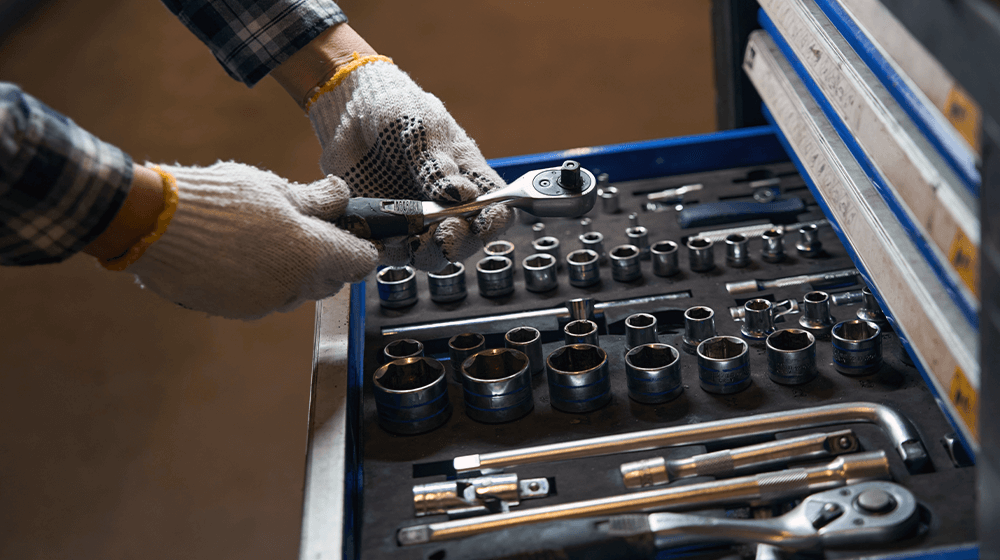
A good automotive tool kit should include a full socket set in both metric and standard sizes, combination wrenches, screwdrivers in multiple sizes and types, pliers, including needle nose and locking varieties, a torque wrench, a rubber mallet, and a set of hex keys. These are the tools you will reach for on almost every single job.
Do not cut corners here. I purchased a budget automotive tool kit early on and ended up stripping bolts and rounding off fasteners due to poor quality. Mid-range brands from reputable manufacturers are the sweet spot. You do not need to buy professional-grade tools right away, but you do need tools that are made from proper materials and hold their tolerances.
Store your automotive tool kit in an organized way from the start. A rolling chest or a wall-mounted system keeps everything accessible and protects your investment. Automotive tools that are thrown loosely into a box get damaged and are harder to find when you are elbow deep in an engine bay.
The Automotive Scan Tool Changed Everything for Me
If I had to choose one automotive tool that genuinely transformed how I approach car maintenance, it would be an automotive scan tool without any hesitation.
Before I owned one, every warning light on my dashboard felt like a mystery that only a mechanic could solve. I would drive to the shop, pay a diagnostic fee of anywhere between fifty and one hundred dollars, and then be told whether the repair was worth doing. That cycle was expensive and time-consuming.
An automotive scan tool connects to your vehicle’s OBD2 port, which is a standardized diagnostic connector found under the dashboard of virtually every car made after 1996. Within seconds, it reads fault codes stored in your car’s computer and tells you exactly what triggered a warning light. It can also clear codes after a repair, read live sensor data, and, in more advanced models, perform system tests.
My first automotive scan tool was a basic handheld unit, and it was useful but limited. I eventually upgraded to a more capable device, and the difference was significant. The better units show you not just the fault code but also what it means, what systems it affects, and what the likely causes are. Some even offer repair suggestions.
If you are buying your first automotive scan tool, look for one that covers your specific vehicle makes and models, supports live data streaming, and has a regularly updated code library. Spend a little more here. This is a tool you will use every single time something feels off with your car.
Understanding Automotive Diagnostic Tools
The term automotive diagnostic tools covers a broader category than code readers. These are the tools that help you investigate, test, and confirm what is actually happening inside your vehicle before you start pulling things apart.
Beyond the scan tool, useful automotive diagnostic tools include a digital multimeter for testing electrical circuits and battery health, a compression tester for checking engine cylinder health, a fuel pressure gauge, a vacuum gauge, and an infrared thermometer for spotting overheating components without touching them.
I use my digital multimeter almost as often as my automotive scan tool. Electrical problems are among the most frustrating issues a car can develop, and without a way to test circuits directly, you end up guessing. The multimeter takes that guesswork away.
When I first started using automotive diagnostic tools properly, my repair success rate went up dramatically. I stopped buying parts based on speculation and started confirming problems with actual data. That shift saved me a significant amount of money in unnecessary parts purchases alone.
One thing worth knowing is that automotive diagnostic tools vary widely in capability. Entry-level tools are fine for reading code and checking basic data. Professional-grade automotive diagnostic tools can perform bidirectional tests, meaning they can actually command vehicle systems to activate, which is useful for things like testing ABS modules or fuel injectors directly.
The Launch Automotive Scan Tool
As you research your options, you will come across the Launch brand fairly quickly. The launch of the automotive scan tool lineup has built a strong reputation among both DIY mechanics and professional technicians, and for good reason.
What sets the launch automotive scan tool series apart is the combination of broad vehicle coverage, deep system access, and a user interface that does not require a professional background to understand. Many basic scan tools only read powertrain codes, which are the most common ones. Still, a launch automotive scan tool typically accesses ABS, airbag, transmission, and body control systems as well. That kind of comprehensive access is valuable when you are dealing with anything beyond a basic engine issue.
I have used a launch automotive scan tool on several occasions and found the live data display particularly useful. Watching oxygen sensor readings, throttle position, and fuel trim values in real time while the engine is running tells you things that a static fault code never could.
For someone serious about DIY maintenance, the launch automotive scan tool is worth considering as either a first purchase or an upgrade from a more basic unit. The investment is higher than entry-level options, but the capabilities justify it.
Essential Hand Tools Every DIY Mechanic Needs
Beyond the diagnostic side of things, your physical automotive tools form the backbone of every repair job. Here is what I have found indispensable over the years of working on my own vehicles.
A quality torque wrench is non-negotiable. Overtightening bolts strips threads and breaks components. Undertightening causes parts to work loose while driving. Automotive tools like torque wrenches give you precision, and that precision protects your vehicle. I use mine on wheel lug nuts, spark plugs, brake caliper bolts, and anything else where the manufacturer specifies a torque value.
A set of pry bars in different sizes handles everything from removing trim panels to separating stubborn components. Combined with plastic trim tools, which protect interior surfaces from scratching, these automotive tools make body and interior work much more manageable.
Floor jacks and jack stands are perhaps the most safety-critical automotive tools in your collection. Never work under a vehicle supported only by a factory scissor jack. A low-profile hydraulic floor jack gets the car up safely and quickly, and a set of sturdy jack stands holds it there while you work underneath. This is one area where buying quality is not optional. It is a matter of personal safety.
A set of breaker bars and impact wrench adaptations helps with stubborn fasteners that have been torqued tight or corroded in place. Stripped bolts are one of the most common ways a simple job becomes a complicated one, and having the leverage to break things free cleanly saves enormous frustration.
Power Tools That Belong in Your Automotive Arsenal
Modern automotive tools include a growing range of cordless power equipment that makes jobs faster and less physically demanding.
A cordless impact wrench is genuinely transformative for tire changes and suspension work. What takes several minutes of manual effort with a breaker bar takes seconds with an impact wrench. I use mine constantly. Look for one with enough torque output for your needs and a battery platform you can share across multiple tools.
A cordless drill with a good set of bits handles drilling out broken bolts, driving screws during body work, and mixing touch-up compounds. An angle grinder with cutting and grinding discs handles rust removal, cutting through corroded exhaust components, and preparing metal surfaces for repair.
These power automotive tools are investments that serve you across dozens of jobs over many years. Buying a single good platform rather than multiple cheap standalone tools is the smarter approach.
Specialty Automotive Tools That Solve Specific Problems
As you take on more varied repairs, you will encounter situations where general automotive tools are not enough. Specialty tools designed for specific jobs make the difference between a clean repair and a damaged component.
Brake piston wind-back tools are essential for rear disc brake service on vehicles where the piston must be rotated as it compresses. Without this tool, you risk damaging the piston seal and creating a bigger problem than you started with. Oil filter removal tools in various styles handle the frustrating reality that filter placement varies wildly between vehicles. A good set of spanner wrenches handles oil pan drain plugs with different configurations.
Timing light tools help with ignition timing on older vehicles. Bearing and seal drivers ensure new components go in straight and are seated properly without damage. CV joint boot clamp tools make axle service cleaner and more reliable.
You do not need all of these automotive tools immediately. Build your specialty collection based on the jobs you actually take on. Research what tools a specific repair requires before you begin, and add to your collection gradually.
Organizing and Caring for Your Automotive Tools
Good automotive tools deserve proper care. A tool that rusts, gets lost, or is damaged through poor storage costs you money twice: once to buy it and once to replace it.
I keep my most used automotive tools on a pegboard wall mount where everything is visible and accessible. Less frequently used items live in labeled drawers in a rolling chest. When I finish a job, everything goes back where it belongs immediately. That habit sounds minor, but it saves real time when you are starting your next project.
Clean your tools after every use. Remove grease and grime before storing them. Light machine oil on metal surfaces prevents rust, especially in humid climates. Sockets and wrenches should be kept dry and away from chemicals that can damage the metal.
Calibrated tools like torque wrenches need periodic recalibration to remain accurate. Check your manufacturer recommendations and send them in for service when needed. A torque wrench that reads incorrectly is worse than not having one at all.
At Paradox Smart Tools, the emphasis is always on quality over quantity. A smaller collection of well-made, properly maintained automotive tools outperforms a large collection of cheap ones every single time.
Building Your Automotive Tool Collection Over Time
You do not need to buy everything at once. When I started, I prioritized the items that would serve me on the most jobs most often: the automotive tool kit, a jack and stands, and an automotive scan tool. Those three investments alone enabled me to handle oil changes, brake work, battery service, filter replacements, and most sensor-related repairs.
From there, I added automotive diagnostic tools as specific needs arose. The multimeter came next. Then the torque wrench and impact wrench. Specialty tools followed as I took on more involved jobs.
Think about what your vehicle actually needs. Research the most common maintenance items and repairs for your specific make and model. That research will tell you which automotive tools to prioritize. Every car is different, and your collection should reflect the vehicle you actually drive.
Automotive Tools and DIY Maintenance

Investing in proper automotive tools is one of the most practical decisions a car owner can make. The savings over time are real, the skills you develop are genuinely useful, and the satisfaction of diagnosing and fixing your own vehicle is something that does not fade, no matter how many times you experience it.
Start with a solid foundation, add an automotive scan tool early, build your automotive diagnostic tools collection thoughtfully, and care for what you own. Whether you are a complete beginner or someone who has been wrenching for years, the right automotive tools make every job more achievable, more efficient, and more rewarding.
Your car is a significant investment. The automotive tools you use to maintain it are the difference between that investment lasting and performing well for years, and slowly deteriorating through neglect or poorly executed repairs. Take the time to build your collection right, and you will thank yourself every single time you pull into your garage instead of a repair shop.
Published as informational guidance for DIY automotive enthusiasts. Always follow manufacturer specifications and safety guidelines when performing vehicle maintenance and repairs.