


5 Article Highlights
- A hygrometer is an essential home gadget that measures relative humidity levels and helps you maintain air quality between 40% and 60% for comfort and health.
- Digital hygrometers are far more accurate and easier to read than traditional analog versions, making them the top choice for modern homes.
- Placing hygrometers in the right rooms, including bedrooms, basements, and nurseries, gives you a complete picture of your indoor air quality.
- Features like data logging, min/max memory, temperature display, and wireless connectivity separate average hygrometers from the best ones.
- Consistently monitoring humidity with a reliable hygrometer can prevent mold growth, protect wooden furniture, and reduce respiratory issues.
Introduction
A few years ago, I started noticing that my wooden bookshelves were warping slightly, my skin felt unusually dry every winter morning, and my basement always smelled a little musty, no matter how often I cleaned it. I had no idea what was causing all of this until a friend suggested I get a hygrometer. That single gadget changed the way I understood and managed my home environment completely.
If you have never used a hygrometer before, you are not alone. Most people do not think about indoor humidity until something goes wrong. By then, the damage, whether to your health, your home, or your belongings, has already started. This article walks you through everything I have learned about hygrometers from personal use, research, and trial and error, so you can make a well-informed decision before you buy one.
What Is a Hygrometer?
Let me answer the most basic question first. What is a hygrometer? A hygrometer is a device that measures the amount of water vapor present in the air, also known as relative humidity. The hygrometer definition, in simple terms, is an instrument that tells you how humid or dry your indoor or outdoor environment is, usually displayed as a percentage.
When relative humidity reads 100%, it means the air is fully saturated with moisture. When it reads 30% or below, the air is quite dry. For most homes, the ideal range falls between 40% and 60% relative humidity. A hygrometer helps you stay within that healthy range.
There are two main types: analog and digital. Analog hygrometers use a moisture-sensitive material that expands and contracts to move a needle on a dial. Digital hygrometers use electronic sensors to detect humidity and display readings on a screen. For home use, a digital hygrometer is almost always the better choice because it is more accurate, easier to read, and often includes extra features like temperature monitoring and historical data tracking.
Why Every Home Needs a Hygrometer
I used to assume that if my home felt comfortable, the humidity was fine. That assumption cost me a warped guitar neck, a season of dry sinus infections, and a mini mold outbreak behind my bathroom vanity. The truth is, you cannot feel humidity levels accurately enough to manage them without a reliable hygrometer.
Here is why humidity control matters more than most people realize.
High humidity above 60% creates the perfect environment for mold, mildew, and dust mites. These are not just unpleasant. They are real health hazards, especially for people with asthma, allergies, or respiratory conditions. If you have children or elderly family members at home, keeping a hygrometer in key rooms is not just smart, it is genuinely responsible.
Low humidity below 30%, on the other hand, dries out your sinuses, causes cracked lips, irritates your throat, and makes you more vulnerable to colds and flu. It also damages wood floors, musical instruments, antique furniture, and anything else that reacts to moisture changes.
A hygrometer for home humidity takes all the guesswork out of this. You see the number, you know the condition, and you act accordingly, whether that means running a humidifier, a dehumidifier, or simply opening a window.
Digital Hygrometer vs. Analog: Why Digital Wins Every Time
When I first started looking for a hygrometer, I almost bought a classic analog dial version because it looked nice on a shelf. I am glad I did not. After reading more about accuracy, I went with a digital hygrometer, and the difference in performance is significant.
A digital hygrometer uses an electronic humidity sensor, usually a capacitive or resistive type, that delivers readings within plus or minus 2 to 5 percent accuracy in most home-grade models. Analog versions can drift considerably over time and may need recalibration every few months. For casual decoration, analog might work. For real monitoring and control, a digital hygrometer is the clear winner.
Digital hygrometers also tend to include built-in thermometers, backlit displays, memory functions for high and low readings, and in many modern versions, Bluetooth or Wi-Fi connectivity. These features make it easy to check your humidity levels at a glance or even from your phone.
Key Features to Look for in a Home Hygrometer
After testing several models personally and reading through hundreds of user reviews, I have narrowed down the features that actually matter in a home hygrometer.
Accuracy and Sensor Quality
The most important thing a hygrometer needs to do is give you an accurate reading. Look for a digital hygrometer that advertises plus or minus 2 to 3 percent accuracy. Anything wider than 5 percent is not really reliable for home humidity management. High-quality sensor chips, often from Swiss manufacturer Sensirion or similar brands, tend to perform best.
Display Readability
A hygrometer that you cannot read easily in a dim room is frustrating to use. Backlit LCD or LED displays are ideal. Large font sizes matter too, especially if you are placing the hygrometer across the room. I keep one on my nightstand and another across the bedroom, and both need to be readable from bed without squinting.
Min/Max Memory Function
This feature records the highest and lowest humidity readings over a period of time. It is extremely useful because humidity fluctuates throughout the day. You might check your hygrometer at noon when conditions look fine, but a min/max memory will show you that humidity spiked to 72% the night before, which is a problem you need to address.
Temperature Display
Most good digital hygrometers also display temperature. This is valuable because temperature and humidity are closely related. Knowing both readings helps you make better decisions about heating, cooling, and ventilation. I find that reading a single device for both helps me understand my home climate much more completely.
Wireless and Smart Features
Some of the newer hygrometer models connect to smartphone apps via Bluetooth or Wi-Fi. These are especially useful if you want to monitor multiple rooms or track data over weeks and months. I use a smart hygrometer in my basement specifically because I do not check it daily, but I can glance at the app whenever I think about it.
Size and Mounting Options
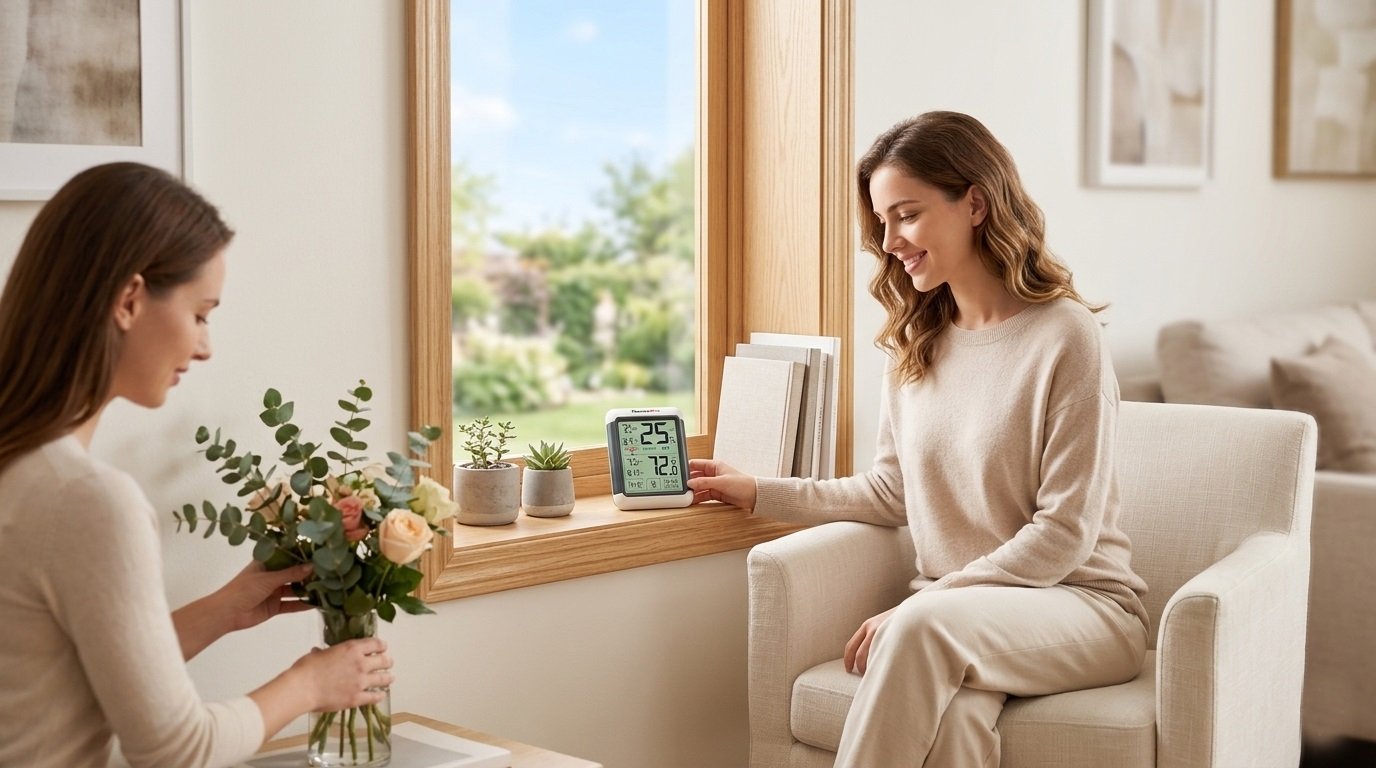
A hygrometer for home use should fit your space without becoming an eyesore. Most units are compact and can sit on a shelf, hang on a wall, or attach magnetically to a surface. Some models include both a stand and wall-mount hardware, which adds flexibility.
Best Rooms to Place a Hygrometer in Your Home
One hygrometer is useful. Multiple hygrometers placed strategically throughout your home are genuinely transformative. Here is where I recommend placing them based on my own experience.
Bedroom
This is the room where you spend roughly a third of your life. Sleep quality, skin health, and respiratory comfort are all affected by bedroom humidity. A hygrometer on the nightstand gives you immediate, actionable data. I noticed my sleep improved noticeably once I started keeping bedroom humidity consistently between 45% and 55%.
Basement
Basements are the most humidity-prone area of any home. They tend to be cooler and more susceptible to moisture from the ground. A hygrometer in the basement helped me discover that my levels were climbing to 68% during summer rainstorms, which explained the musty smell I could never get rid of. Once I added a dehumidifier guided by the hygrometer readings, the problem disappeared within two weeks.
Nursery or Children’s Room
Children, especially infants, are more sensitive to air quality than adults. A digital hygrometer in the nursery helps you maintain the ideal environment for healthy breathing and comfortable sleep. Many parents I know now consider a hygrometer as essential as a baby monitor.
Kitchen and Bathroom
Cooking and bathing create sudden spikes in humidity. Placing a hygrometer near these areas helps you know when to use exhaust fans and for how long. Without a hygrometer, most people turn off the fan too soon, leaving residual moisture that leads to mold on grout and caulking.
Home Office or Music Room
If you work with electronics, store documents, or play musical instruments, humidity control matters for preservation. A hygrometer in these spaces protects your investment and ensures consistent performance conditions.
How to Use a Hygrometer Effectively
Buying a hygrometer is only the first step. Using it well takes a bit of consistency and attention. Start by placing the hygrometer away from direct sunlight, vents, and exterior walls. These locations can skew readings significantly. Give the device at least 30 minutes to adjust to the room before trusting the initial reading.
Check the hygrometer at different times of day, especially morning and evening, to understand how humidity changes in your home. Track the min and max readings over a week to identify patterns. You might find that your living room peaks in humidity after cooking dinner, or that your bedroom dries out significantly when the heating runs all night.
Once you understand your baseline, use a humidifier or dehumidifier as needed and monitor changes with the hygrometer in real time. This feedback loop is what makes a hygrometer genuinely useful rather than just decorative.
Calibrating Your Hygrometer
Even the best digital hygrometer can drift slightly over time. Calibration ensures your readings stay trustworthy. The most common home method is the salt test, which involves placing the hygrometer near a sealed container of saturated salt water for several hours. At equilibrium, the reading should display close to 75% relative humidity. If it does not, you can adjust using the calibration button on most models.
I recommend calibrating a new hygrometer before first use and then rechecking it every three to six months. It takes about 20 minutes and takes the guesswork out of whether your device is still accurate.
Top Digital Hygrometers Worth Considering
Having used and researched many models, here are the types that consistently deliver strong performance for home use.
Compact Tabletop Models
These are the most common and affordable categories. A good compact digital hygrometer typically costs between 10 and 25 dollars and covers a single room effectively. Look for models with high-contrast displays and the min/max memory feature. Brands like ThermoPro, Govee, and Inkbird have built solid reputations in this space.
Multiroom Wireless Systems
If you want to monitor your entire home, wireless sensor systems let you place remote hygrometer sensors throughout the house and read all the data on a central display or smartphone app. These are ideal for larger homes where the basement, attic, and living spaces may have very different humidity profiles. The investment is higher, often 40 to 80 dollars for a full kit, but the visibility you gain is worth it.
Smart Home Compatible Hygrometers
For people with smart home systems like Amazon Alexa or Google Home, certain hygrometer models integrate directly and can trigger automations based on humidity thresholds. For example, you could set a rule that turns on a dehumidifier plug when humidity exceeds 60%. This kind of automation turns passive monitoring into active home management.
At Paradox Smart Gadgets, we believe that every home deserves accurate, reliable environmental monitoring, and a quality hygrometer is one of the most cost-effective smart Gadgets you can add to your living space.
Common Mistakes People Make With Hygrometers
After talking to other users and learning from my own experience, I have seen the same mistakes come up repeatedly.
Placing the hygrometer near a window or vent is the most common error. This distorts readings because you are measuring the conditions near the draft or sunlight, not the actual room environment.
Trusting a hygrometer without ever calibrating it is another issue. Out-of-the-box accuracy varies between units and can drift, so calibration is always worthwhile.
Ignoring the readings is perhaps the biggest mistake of all. A hygrometer is only useful if you act on what it tells you. Make a habit of checking it regularly and responding to readings that fall outside the 40 to 60 percent range.
Finally, buying only one hygrometer for a large home gives you incomplete information. Each room has its own humidity profile, and a single device cannot capture the full picture.
Humidity Control Gadgets That Work With Your Hygrometer
A hygrometer measures, but you also need gadgets to act on what it tells you.
A humidifier adds moisture to dry air, which is especially useful in winter when heating systems strip humidity from your home. Pair one with a hygrometer to avoid over-humidifying, which can cause its own problems.
A dehumidifier removes excess moisture and is essential for basements, crawl spaces, and humid climates. Many modern dehumidifiers have built-in humidity sensors, but having a standalone hygrometer gives you an independent reading to verify accuracy.
Exhaust fans in bathrooms and kitchens help vent steam before it raises ambient humidity. Using a hygrometer in these rooms tells you exactly how long to run the fan after a shower or cooking session.
Ventilation through windows and air exchangers is the most natural way to balance humidity when outdoor conditions allow. A hygrometer helps you decide when opening windows helps and when it makes things worse, particularly in humid summer weather.
My Personal Experience and Opinion
I genuinely did not think much about indoor humidity until I had a hygrometer in my hand and started seeing actual numbers. Once I did, I could not unsee them. The readings explained so many small problems I had been living with and dismissing as normal.
A good digital hygrometer is one of the most affordable, practical, and underappreciated gadgets you can add to your home. Whether you are dealing with allergy symptoms, protecting musical instruments, keeping a basement dry, or simply optimizing your sleep environment, a hygrometer gives you real data to work with instead of guesswork.
Start with one in the room that concerns you most, whether that is a damp basement or a dry bedroom, and expand from there. Once you see how simple and informative it is to monitor home humidity with a reliable hygrometer, you will wonder how you managed without one.