
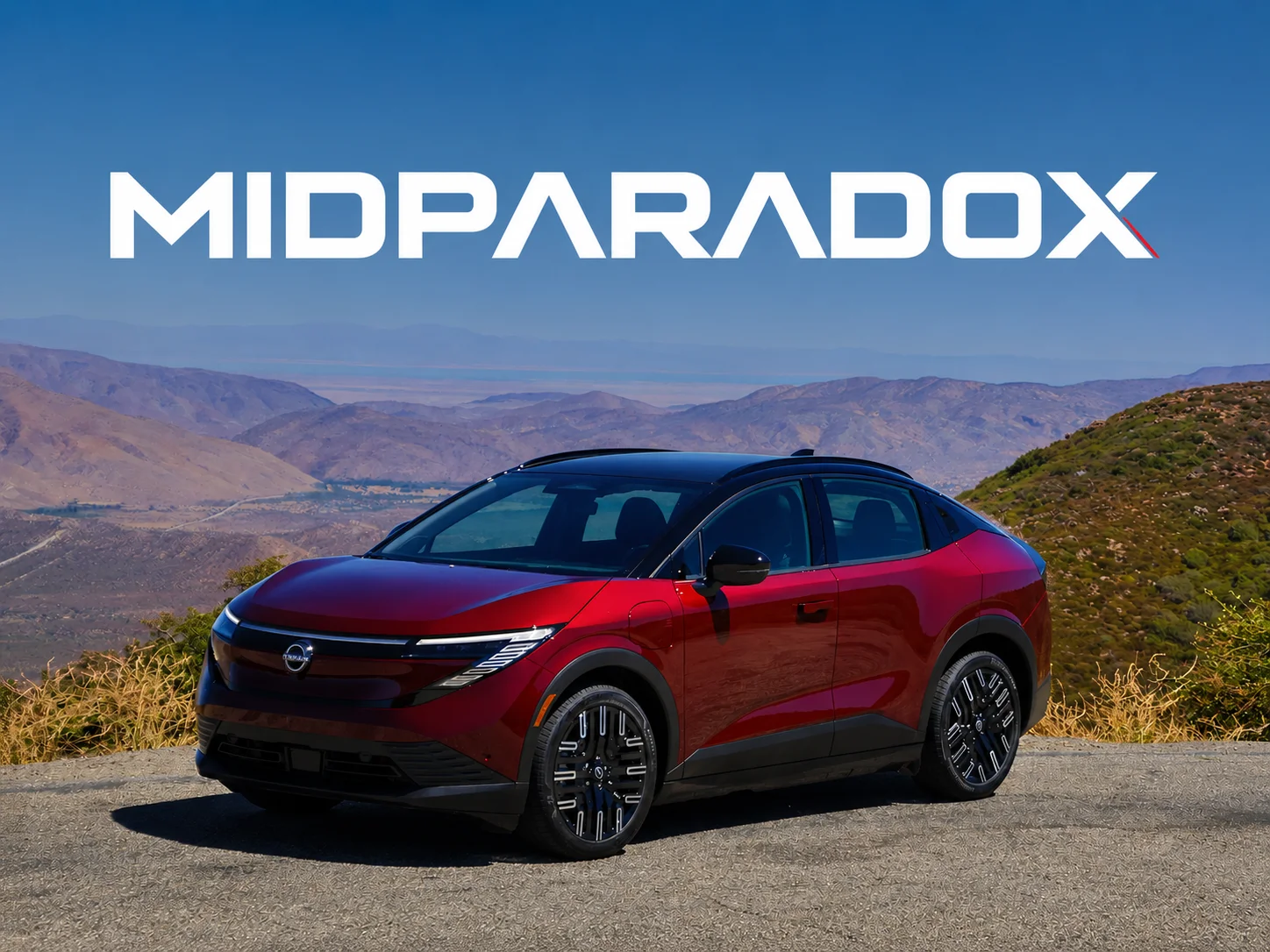


The electric vehicle market has never been more competitive, yet for most buyers the single biggest barrier remains price. That is exactly why the arrival of the third-generation 2026 Nissan LEAF S+ has sent genuine excitement through the EV community. Nissan officially confirmed an MSRP starting at $29,990 making the Nissan LEAF S+ the lowest-priced new electric vehicle currently on sale in the United States. When you factor in the federal EV tax credit of up to $7,500, the real-world cost drops closer to $22,000, which is territory that was unthinkable just a couple of years ago for a modern, capable EV.
A Complete Reinvention
One of the most common questions people ask is whether the 2026 LEAF is just a tweaked version of the old hatchback. The answer is an emphatic no. Nissan has torn up the old design and started completely from scratch. The third-generation LEAF has transformed from a compact five-door hatchback into a sleek electric crossover SUV raising the driving position, widening the cabin, and adding meaningfully more cargo space than its predecessor, all without growing the exterior footprint in an unmanageable way.
The styling is sharper and more self-assured than the famously quirky old LEAF. Sharp character lines, a flush-fitted grille, and sculpted flanks give the new car a presence on the road that the previous generation never quite achieved. It is the kind of design that no longer asks you to advertise that you are making an eco-conscious choice; it simply looks like a handsome, modern crossover.
Inside, the cockpit has been completely modernized. The Nissan LEAF S+ trim comes standard with dual 12.3-inch screens, a driver information display and an infotainment panel along with wireless Apple CarPlay and wireless Android Auto as standard features. That level of technology at this price point is genuinely impressive and addresses one of the most common criticisms of the outgoing model’s interior quality.
Range and Battery
Here is where the 2026 Nissan LEAF S+ truly separates itself from the affordable EV crowd. The S+ trim is powered by a 75 kWh liquid-cooled lithium-ion battery paired with a 214-horsepower electric motor delivering 160 kW of output. The EPA-estimated range sits at a remarkable 303 miles per charge, a figure that puts it in direct competition with vehicles costing significantly more.
Real-world highway testing at 70 mph in mild conditions has shown the S+ holding between approximately 255 and 270 miles, which represents around 84 to 89 percent of the EPA figure, an honest and respectable result. Range anxiety, that nagging psychological barrier that still holds many people back from switching to electric, is genuinely not a concern with this car for the vast majority of everyday driving scenarios.
The S+ trim is also the range leader in the entire LEAF lineup, outpacing the pricier SV+ at 288 miles and the top-of-the-range Platinum+ at 259 miles. That inversion where the cheapest trim delivers the most range is unusual and speaks to Nissan’s deliberate effort to make the most compelling specification the most accessible one.
Finally Keeping Up with the Competition
The previous generation Nissan LEAF was frequently criticised for its CHAdeMO fast charging standard, which was becoming increasingly difficult to find in the real world. Nissan has addressed this decisively in the 2026 model. Every trim now comes equipped with a NACS (North American Charging Standard) port — the Tesla-style connector that is now the dominant DC fast charging standard across North America.
This opens direct access to more than 17,000 Tesla Supercharger stations alongside a rapidly growing network of third-party NACS-compatible chargers. For Level 2 AC charging, a J1772 port on the driver’s side keeps things compatible with home wallboxes and public Level 2 stations. The DC fast charging rate maxes out at 150 kW, allowing the 75 kWh battery to go from 10 percent to 80 percent in approximately 35 minutes — a dramatic improvement over the old model and genuinely competitive with class rivals. For home charging, a standard Level 2 connection will fully replenish the battery overnight with ease.
Nissan also incorporated a heat pump and battery heater into the thermal management system, which helps maintain charging efficiency and driving range in cold weather conditions, a critical real-world improvement that owners in northern climates will appreciate enormously.
Standard Features That Surprise
What makes the Nissan LEAF S+ story even more compelling is the list of safety and technology features that come as standard at its price point. Nissan has bundled the full Safety Shield 360 suite into every trim, which includes automatic emergency braking with pedestrian detection, blind spot warning, rear cross-traffic alert, lane departure warning, and rear automatic braking. Adaptive cruise control and automatic parking assistance are also included in the S+ specification.
USB Type-C charging ports sit at the front for device power, and the wireless smartphone integration means there are no cables cluttering the centre console. Keyless entry and a push-button start round out the convenience features. For a vehicle under $30,000, this is a specification sheet that would have seemed extraordinary just three or four years ago.
How Does It Stack Up Against the Competition?
The natural rivals for the Nissan LEAF S+ include the Chevrolet Bolt EV, the Kia Niro EV, the Hyundai Kona Electric, and the redesigned Toyota C-HR. Most of these competitors carry a higher starting price than the S+, and none of them match its 303-mile range figure in the sub-$30,000 bracket. The Bolt EV comes closest on price but delivers less range, while the Kona Electric and Niro EV offer strong features but at meaningfully higher MSRPs.
If you are genuinely comparing what you get per dollar spent in the affordable EV segment right now, the 2026 Nissan LEAF S+ is extraordinarily difficult to beat. The closest comparison is probably to say that Nissan has simply moved the goalpost for what a budget EV is allowed to be.
Is the Nissan LEAF S+ the Right EV for You?
For anyone whose daily driving falls under 80 to 100 miles — and that describes the overwhelming majority of American commuters — the 303-mile range of the Nissan LEAF S+ provides enormous breathing room. Weekend road trips, occasional longer journeys, airport runs, all of these fit comfortably within the car’s real-world capability without needing to plan around charging stops the way you might with a shorter-range vehicle.
If you have access to a home charger, even a basic Level 2 wallbox, ownership becomes exceptionally straightforward. You leave every morning with a full battery and never think about fuel costs again. At current electricity rates, the cost per mile in an EV like the LEAF is dramatically lower than any petrol-powered equivalent at a similar price point.
The main trade-off to consider is that the S+ is front-wheel drive only, and the more premium SV+ and Platinum+ trims add creature comforts like heated seats, leatherette upholstery, and larger 18-inch aluminium wheels. For buyers who want those features, the step up to SV+ at $34,230 is worth exploring. But if raw value for money and maximum range matter most, the Nissan LEAF S+ is the trim to choose and the one Kelley Blue Book analysts have identified as the most popular buy in the lineup.
Nissan’s Legacy in Electric Mobility
It is worth taking a moment to appreciate the context. The Nissan LEAF was the world’s first mass-market electric car when it launched in 2010, and over the course of its life the nameplate has accumulated more than 18 billion miles driven worldwide. That heritage has given Nissan an unmatched depth of real-world EV data, informing how the 2026 model was engineered and tested more than 1,500 days of testing across locations spanning the deserts of the American Southwest to the extreme cold of Fairbanks, Alaska.
The fact that the 2026 Nissan LEAF S+ starts at $29,990, a lower price than the original 2011 LEAF’s $32,780 sticker, while delivering a completely different level of capability, range, and technology is a remarkable statement about how far the technology has come and how seriously Nissan has taken its mission to make electric mobility accessible to everyone.
Worth Every Cent
The 2026 Nissan LEAF S+ is not a compromise. It is not an underpowered, under-featured entry-level vehicle that exists purely to satisfy a price point. It is a genuinely well-rounded, properly capable electric crossover that happens to start at the most accessible price of any new EV in America. The 303-mile range leads the affordable EV segment outright, the NACS fast charging integration finally resolves the old model’s biggest weakness, and the full Safety Shield 360 suite ensures you are not sacrificing safety to save money.